
 For Immediate Release – September 11, 2026
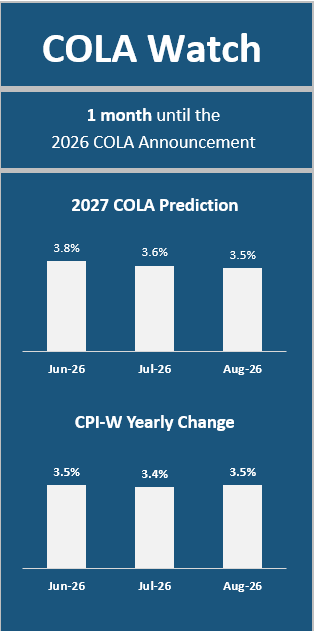
TSCL predicts that Social Security’s 2027 Cost of Living Adjustment (COLA) will be 3.5 percent. This figure is 0.1 percentage points lower than last month’s prediction, and it would be 0.7 percentage points higher than the 2.8 percent COLA for 2026. That’s also 1.0 percentage point higher than 2025’s COLA of 2.5%.
The Social Security Administration will announce the official 2027 COLA on October 14th. The government calculates the COLA by taking the average yearly change in the Consumer Price Index for Urban Wage Earners and Clerical Workers (CPI-W) for July, August, and September. The August CPI-W, released today, came in at 3.5 percent. The July CPI-W, released last month, came in at 3.4 percent.
If TSCL’s projection holds, average benefit checks will increase by $67.90. The current average beneficiary receives $1,940.08 in their monthly Social Security check. With a 3.5 percent COLA, that would rise to $ 2,007.98.
Key Insights:
-
- This is TSCL’s final prediction for the 2027 COLA. Social Security will make the official announcement on October 14th when the Bureau of Labor Statistics (BLS) releases the CPI-W for September.
-
- Social Security beneficiaries will see the new COLA take effect on January 1st, 2027. The COLA will apply a percentage increase to all benefit checks. For example, if a beneficiary’s monthly check is $2,000, TSCL’s predicted COLA of 3.5 percent would increase their check to $2,070.
-
- Seniors have expressed strong dissatisfaction with the last two COLAs. According to TSCL’s 2026 Senior Survey, 89 percent of older Americans thought the 2026 COLA was too low, and their monthly benefit checks would fall behind inflation. The survey also finds that 44 percent of seniors draw all their income from Social Security.
TSCL Executive Director Shannon Benton says…
-
- “The biggest thing we’re watching with the COLA announcement coming are short-term shocks to the economy that push inflation way up or down in the next 30 days. Of the three CPI-W figures used to calculate the COLA, two are already in.”
- “No matter if the COLA announcement comes in slightly higher or slightly lower than our prediction, seniors will probably end up disappointed in the long run. The reality is that older Americans allocate their budgets differently than people still in the workforce, so inflation hits them differently. The CPI-W captures the experience of urban wage earners, which doesn’t represent the average senior’s budget.
- “The COLA only happening once a year puts life on hold for a lot of seniors. When prices rise, they don’t rise next January when your benefit check goes up. They rise right now. We need to consider CLAs that compound quarterly or monthly so seniors can keep up throughout the year when inflation comes in above Federal Reserve targets, like in 2026.”
About TSCL:
The Senior Citizens League (TSCL) is one of the nation’s largest nonpartisan seniors’ groups. Established in 1992 as a special project of The Retired Enlisted Association, our mission is to promote and assist our members and supporters, educate and alert senior citizens about their rights and freedoms as U.S. citizens, and protect and defend the benefits seniors have earned and paid for. TSCL consists of vocally active senior citizens concerned about the protection of their Social Security, Medicare, and veteran or military retiree benefits. To learn more, visit https://seniorsleague.org/about-us/.
About the TSCL COLA Model:
TSCL issues a new prediction of the next COLA for Social Security each month using our statistical model. The model incorporates the Consumer Price Index, the Federal Reserve interest rate, and the national unemployment rate to make its predictions. The model’s predictions update throughout the year, adjusting in response to economic conditions. For additional information about the model, contact Alex Moore, TSCL’s statistician, at amoore@tsclhq.org.
We released a new version of the model, v1.2, in January 2025. The new version updates the model’s data handling, processing data according to the federal fiscal year rather than the calendar year. The new model also reduces each prediction’s reliance on previous predictions made throughout the federal fiscal year.
Contact Information:
Shannon Benton, Executive Director: sbenton@tsclhq.org; 703-548-5568
Alex Moore, Statistician: amoore@tsclhq.org; 571-349-2658
